OBJECTIVES OF HUMAN RESOURCE MANAGEMENT

Human Resource Management, Simply Refers To The Administration Of Human Resources.
HRM means Human Resource Management. HRM is the efficient and effective utilization of human resources to achieve the goals of an organization.
But future of HRM will be functioned towards data driven decision making and will be prioritized employee well being.
Lets have a look at the main objectives of HRM
What are the Objectives of HRM?
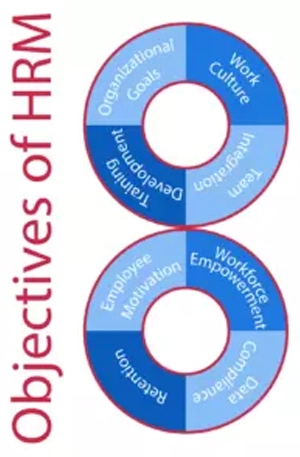
Below are 10 primary objectives of human resource management with in-depth elaboration respectively:
- 1.Achieve Organizational Goals
2.Health, Safety and Overall Well-being of Employee
- 3.Succession and planning
- 4.Work Culture
- 5.Team Integration
- 6.Training and Development
- 7.Employee Motivation
- 8.Workforce Empowerment
- 9.Retention
- 10.Data and Compliance
1. Achieve Organizational Goals

Achieving goals is a critical component of personal and professional development. It involves setting clear, actionable objectives and systematically working toward them. Several models and theories can help explain how to effectively achieve goals, with key strategies drawn from research in psychology and organizational behavior. Below are some key points and references to guide goal achievement:
One of the most widely known frameworks for achieving goals is the SMART criteria. This method encourages the setting of Specific, Measurable, Achievable, Relevant, and Time-bound goals. Research has shown that setting SMART goals leads to greater clarity and focus, enhancing the likelihood of success (Locke & Latham, 2002).
Achieving organizational goals is a multifaceted process that involves strategic planning, effective leadership, clear communication, resource management, and continuous monitoring and evaluation. Below are key strategies and concepts to help an organization meet its goals, supported by references:
1. Setting SMART Goals

To achieve organizational goals, they need to be clearly defined. The SMART framework helps ensure that the goals are specific, measurable, achievable, relevant, and time-bound (Doran, 1981). By following SMART criteria, organizations can set realistic and actionable objectives, which provides a roadmap for success.
Reference:
Doran, G. T. (1981). There's a S.M.A.R.T. way to write management's goals and objectives. Management Review, 70(11), 35–36.
2. Strategic Planning and Alignment
.jpg)
Organizational goals should align with the company’s overall mission and vision. Strategic planning involves developing long-term plans and breaking them down into smaller, actionable objectives. This alignment ensures that every team and department is working toward the same overarching goals.
Reference:
Kaplan, R. S., & Norton, D. P. (1996). The Balanced Scorecard: Translating Strategy into Action. Harvard Business Review Press.
3. Leadership and Decision-Making
Effective leadership is essential for guiding the organization toward its goals. Leaders must make informed decisions, inspire their teams, and adapt to changing circumstances. Transformational leadership, which emphasizes motivating employees to exceed expectations, can drive organizational success (Bass, 1985).
Reference:
Bass, B. M. (1985). Leadership and performance beyond expectations. Free Press.
4. Clear Communication and Collaboration

Open lines of communication are crucial for the success of an organization. When leaders clearly communicate the vision, mission, and goals, it fosters alignment across all levels of the organization. Encouraging collaboration and feedback among team members also enhances productivity and innovation.
Reference:
Clampitt, P. G., & Berk, L. E. (2001). Communication and organizational effectiveness. Journal of Business Communication, 38(3), 74-89.
5. Resource Management
Achieving goals requires efficient resource management, including human, financial, and technological resources. The allocation of resources should be prioritized based on the strategic importance of the goals. Regular assessments can ensure that resources are being used effectively.
Reference:
Barney, J. B. (1991). Firm resources and sustained competitive advantage. Journal of Management, 17(1), 99-120.
6. Performance Measurement and Monitoring
Tracking progress towards organizational goals is crucial to identify any deviations and adjust strategies accordingly. Using performance metrics like KPIs (Key Performance Indicators) or the Balanced Scorecard allows organizations to continuously assess their progress and make data-driven decisions (Kaplan & Norton, 1996).
Reference:
Kaplan, R. S., & Norton, D. P. (2001). The Strategy-Focused Organization: How Balanced Scorecard Companies Thrive in the New Business Environment. Harvard Business Press.
7. Continuous Improvement (Kaizen)
Organizations that embrace continuous improvement can better achieve their goals by constantly refining processes and adapting to change. The concept of Kaizen, which emphasizes incremental, continuous improvements, is a key component of achieving long-term success (Imai, 1986).
Reference:
Imai, M. (1986). Kaizen: The Key to Japan’s Competitive Success. McGraw-Hill.
8. Employee Engagement and Motivation
An engaged and motivated workforce is critical to organizational success. Organizations should create a positive work culture, offer development opportunities, and recognize employee achievements to maintain high levels of motivation.
Reference:
Harter, J. K., Schmidt, F. L., & Hayes, T. L. (2002). Business-unit-level relationship between employee satisfaction, employee engagement, and business outcomes: A meta-analysis. Journal of Applied Psychology, 87(2), 268-279.
Conclusion
Achieving organizational goals is an ongoing process that requires alignment, effective leadership, clear communication, resource management, and a commitment to continuous improvement. The strategies mentioned above provide a framework for organizations to stay focused and proactive in achieving their objectives.


Great insights! The blog provided a clear understanding of HRM objectives.
ReplyDeleteIn depth article with good information. Valuable facts. Good luck with your good work
ReplyDeleteObjectives of HRM is unique. And also it provides a clear understanding.
ReplyDeleteWho are the reader he can get insight knowledge regard objectives of HRM.
ReplyDeleteWith reference to your article, HRM are essential for ensuring that an organization operates effectively manage and handling human resources in a strategic and efficient way in every organization. You explained it very smooth way. Great work.
ReplyDeleteHelpful article with better expalantions. Regarding second point, does it means one of the HRM objectives is creating suitable work culture?
ReplyDeleteHuman Resource Management (HRM) is a crucial function in any organization because it ensures that the workforce is effectively managed, motivated, and aligned with organizational goals.
ReplyDeleteGood article summarizing overall HRM and key areas.
ReplyDeleteThis blog does an excellent job of highlighting objectives of HRM
ReplyDeleteThe objectives of HRM have been well explained. Good one.
ReplyDeleteThank you for this insightful article on Objectives of Human Resource Management. It clearly outlines how HRM aims to align employee performance with organizational goals while fostering a supportive and productive work environment. A valuable read!
ReplyDeleteWell done! You've provided a comprehensive overview of the key objectives of Human Resource Management. Your explanation clearly highlights the importance of aligning HR practices with organizational goals, promoting employee well-being, and ensuring a productive work environment. Great work in emphasizing the strategic role HR plays in business success!
ReplyDeleteGreat Post. It clearly explains objective about HRM.
ReplyDeleteThe objectives of HRM, from optimizing employee performance to fostering a positive work environment, are essential in driving organizational success. Wishing you continued success in sharing valuable insights on this topic. great work!
ReplyDeleteGreat job. Objectives of HRM have been explained well.
ReplyDeleteVery comprehensive article. You have covered all areas related to HRM objectives with practical examples. Very helpful!
ReplyDeleteHRM is the most important thing in any place. It's about caring for human feelings along with achieving the entire organizational growth.
ReplyDeleteYour article offers a comprehensive exploration of the objectives of Human Resource Management, effectively highlighting its multifaceted role in achieving organizational success. By emphasizing the importance of aligning HRM practices with organizational goals, you underscore the strategic value of HR in driving performance and growth. Additionally, your focus on employee well-being, including health and safety, reflects a deep understanding of HRM's role in fostering a supportive and productive work environment. The inclusion of contemporary considerations such as data-driven decision-making and compliance further enriches your analysis, providing readers with a well-rounded perspective on modern HRM practices. Overall, your insights contribute significantly to the discourse on effective HRM strategies and their impact on organizational excellence.
ReplyDelete